Wednesday, November 1, 2017

2017 Oct - Veena Concert by Nirmala Rajasekar


Veena- Nirmala Rajasekar 

Violin - VVS Murari 

Mridangam - Thanjavur Murugabhoopathy

Kanjira – Dr. S. Ramakrishnan


We had to miss the 2017 Navarathri in South Florida as we celebrated our Shashti Abda Poorthi in India during that time.  So, how is life after 60?  Our good family friend Dr. Shanthi Sundaram told me “A new life starts after 60 and this part of your life is really the most important part”.  Wow, really?  The truth in that statement hit me quite hard.  Till now we built a family, brought up the kids, built a career, took in a lot of stress, music/dance/Tae Kwon Doe lessons for the kids, arangetrams and performances, traveled several million miles, chased growth at the expense of the health etc. – basically the usual stuff everyone goes through.  In spite of all these activities, thankfully, we found some time for religion and spirituality.  But now it is time to clearly refocus my life.  After all, how many more years in this planet?  Clearly, the road traveled is longer than the road ahead in this life.  So, make every step count.  I am thankful to all the Guru’s in my life, in person or virtual, who laid the foundation for my spiritual path and religious path.  Over the years, these Gurus have built an unshakeable faith in Advaita Vedanta and Hindu Religious practices within me.  It will be up to me to fan the spark, grow within and prepare for next life.  I seek the blessings of all those who are further ahead of me in the path and I want to draw inspiration from everyone I meet.  Ok, let us go to the concert.


Veena concert is a rare occasion, especially for those of us living outside of India.  In talking to the artists and other musicians I learned that Thanam has a special place in Veena concerts.  If I may say so, Nirmala played Ragam-Thanam-Krithi in place of Ragam-Thanam-Pallavi in Purvi Kalyani as the main piece.  The Thanam part was elaborate and the percussionists joined in to give us a treat.  Overall, the concert had captivated the audience – where did the stress go.  When a musician connects with the audience you know it is going to be divine.  The artist was able to express the emotions within the song with the instrument which made all the difference.  It had a good mix of melodious songs, fast songs and popular songs.  It was nice to have both Mridangam and Kanjira – the transition between Veena/Mridangam to Violin/Kanjira was seamless and flawless.  There were times they mixed it up as well – nice.  Everyone went away with a smile on their face – great job.  Let us go to song by song.


Sahana varnam/Adi - Beautiful choice of ragam to start the concert. Very captivating rendition. Fingers flying through the instrument at the second speed. With seasoned accompaniments it was a treat


Jaya jaya in Natai/Khanda Chapu – beautifully gliding through the notes. She suddenly picked up the microphone to sing a few lines – it was a pleasant surprise.  Later we found out that she is a seasoned vocalist as well and it clearly showed.  Mridangam and Kanjira fell in sync from the get go. Great to see the musicians enjoying themselves a sure sign of a good concert. Very elaborate swarams with seamless handoffs between veena and violin and correspondingly between mridangam and kanjira. 


Raghuvamsa Sudha in Kadana kuthuhalam/Adi – Veena is probably the best instrument for this song. Made the audience happy with this toe-tapping number - beautifully rendered. 


Rama nee samanam Evaro in Kara Kara Priya/Rupakam – I will be honest here – this is not exactly my favorite ragam.  This ragam and song made a lot of musicians and hard core music lovers very happy.    One of these days I grow enough in appreciating music to develop a taste for this ragam, sorry for now, I muscled through the song.


Meenakshi mamava in Purvi Kalyani/Adi – Very enjoyable alapana with some beautiful phrases. Violin rose to his full height during alapana.  Some parts of the alapana was very meditative and touched many hearts.  Unexpectedly she went to play Thanam and Mridangam/Kanjira joined in.  Very enjoyable interaction between the percussionists.  When she went into the Krithi we were just spellbound.  At many places she sang along with the Veena - great.  Neraval and swarams took us to a different level – no sign of stress. 


Enna thavam seithanai in Kapi/Adi – Effortless playing.  Brought out the emotions of the song. 


The concert ended with an Annamacharya keerthanai in Revathi followed by the ever popular Ragee Thantheera and finally a Thiruppugazh.

Sunday, June 25, 2017

2017 Jun - Sanjana Chandran Violin Concert


Sanjana Chandran successfully completed her solo violin Arangetram (more like an awesome concert) on Jul 17, 2017 at the Rose and Alfred Miniaci Performing Arts Center in Fort Lauderdale, FL. 


Sanjana just completed middle school and will be going to ninth grade.  Many of us in South Florida has seen her grow into this fantastic talent.  Clearly Sanjana is the best Carnatic Violin talent in North America in her age group and even above her age group.  Sanjana is a prodigy, period – God bless her.  Jayanthi joins me in showering our blessings to this talented child.  May Sanjana get everything her heart desires and continue to grow her musical abilities.


I have often wondered how prodigies come into being.  One can argue Sanjana’s dad, Sanjay Chandran, is an awesome violin player and the daughter is following his footsteps.  We have also seen mother handing down dance talent to her daughter.  But there is something more to it than just family background.  We have seen talent does not always get handed down generation to generation and we have also seen talents come out of unlikely places.  So, how does this work?  The answers are in Hindu Scriptures, more specifically in Vedantic texts.  We are all born with certain tendencies – the technical term used for tendencies is “Vasanas”.  The belief is that we choose to be born in an environment conducive to fulfil our vasanas.  These vasanas exert pressure on each of us to take up certain fields and if there is encouragement we blossom.  Just imagine if Sachin Tendulkar was forced to play volley ball the world would have lost a top cricketer.  Even if we don’t get the encouragement early on, the vasana pressure is relentless and it will come out later in life when we least expect it.  So, as parents, we should all watch for the natural talent exhibited by our kids and provide our support.  It could be in the field of mathematics, writing, music, sports, computers, science or whatever.  Each kid is unique with specific innate talent.  Our congratulations to Sapna and Sanjay for spotting and nurturing Sanjana with her skills.  All right – let us go to the concert, I am going to stop calling it an Arangetram.


Sanjana played with seasoned percussion players Dr. S. Ramakrishnan on the Mridangam and Dr. Ravi Balasubramanian on the Ghatam.  But she was not intimidated at all – in fact Sanjana overshadowed them with her sheer skill.  Sanjana demonstrated that she clearly understood the ragas she was presenting masterfully.  Music is all about conveying emotions and Sanjana clearly understood that when presenting the songs.  The song choices were fantastic and the ragas had the entire spectrum from speed to being meditative.  Entire audience was completely engrossed in the performance and Sanjana enjoyed playing every song.  The main piece was in Sankarabharanam, a real delight with all the accoutrements – an elaborate alapana, neraval, swaras and thani.  After watching a lot of reality shows we have all become critics, but none of us could find even a single instance of off-key in Sanjana’s violin.  In the second half, we were joined by Sanjana’s cousin Agasthya on the flute – another pure delight.  Agasthya was only 11 years old and what a joy, God bless you.  We learned a lot from the MC, Sunita, who kept us engaged through the concert.


Varnam in Todi/Adi – Era napai 

Very melodious start to the concert.  Sanjana picked up confidence as she went on.  Nice transition from first to second kalam (speed).


Sri Maha Ganapathi Rava Thuma in Gowle and Mishra chapu 

Sanjana has settled down and is completely relaxed.  She was very comfortable with the ragam.  Very elaborate song with beautiful swarams.


Akhilandeshwari in Dwijawanthi/Adi

Really beautiful alap that captivated the audience.  Start of the song sounded like a seasoned professional.  Expression was so amazing it brought tears to my eyes.  It was clear she enjoyed playing the song.  Connected with the audience with the emotion in the song and once that happens, ladies and gentlemen, it is real music.


Gnanamu sagarada in Purvikalyani and Rupakam

Wow, no other words.  Deft handling of the bow.  She knew the intricacies of the raga well.  Sometimes it felt like there were two violinists on stage one for each percussion artist as she switched between octaves for Ghatam and Mridangam.


Bhogendra sayeenam in Kundalavarali and Kanda Chapu

This is always a crowd pleaser being a fast number and Sanjana played it elegantly.  Felt like we were sitting in front of a seasoned artist. 


Ka Va Va in Varali and Adi

Sanjana’s expression during alap is remarkable.  This song is in a pleading tone inviting Lord Muruga.  She brought out that emotion as meant by the poet.  She completely overshadowed the seasoned percussionists and they were happy to be overshadowed.  The song put the entire audience in a meditative mood.


Brova baramma in Bahudari and Adi

This was another fast number.  The Professors, I mean the Percussionists, seemed to enjoy themselves. Lot of scope for them in the song. 


Saroja dala nethri in Sankarabharanam and Adi

I just stopped taking notes and being completely engrossed in the beauty of the song.  Sankarabharanam is considered one of the “ghana” ragas and it has been played for eons by stalwarts.  The expectation is always very high when this raga is chosen.  The artist will have to put their full into it and show that they understand the nook and cranny of the raga.  Sanjana did complete justice to this raga and song.  She started with a bright alap and went into the song confidently.  The swaras and neravals were at a professional level. 


Thani

Just awesome by the dynamic percussion duo. 


Manavyala kim chara in Nalinakanthi and Adi

During this song Agasthya joined in with his Flute.  Sanjana by now owned the stage and she was a picture of confidence. Effortless delivery, nicely done.


RTP in Keeravani and Kanda Jathi Triputai

Very mature alapana and very soulful.  Flute alapana blew every one away making us look for Gopi's and cows to come through the doors anytime.  They both took us to a meditative state bringing the thoughts down to practically zero state. 


The concert closed with Krishna nee begane baro in Yamuna kalyani and mishra chapu, Chinnanchiru kiliye in raga malika, English note and finally Bhagyatha lakshmi baramma.


Tuesday, May 16, 2017

2017 May - Amrita Murali Concert

Vocal - Amrita Murali
Violin – R.K. Shriramkumar
Mridangam – Arun Prakash

President Trump is a head scratcher even for hardened conservatives.  Sure many Americans were disheartened by the corruption in Washington, deadlock in Congress, sky high deficit and deep polarization in the country.  Many in the country were downright angry at the establishment.  We definitely needed a change.  We needed a leader who can unite the country, break up the log jam and get things done.  But, Trump?!  It seems like we are hitting a new low every day.  Where are we headed – international disgrace, impeachment, escalation of conflicts around the world?  Where are the leaders in this great nation?  I would love for this nation’s youngsters to be motivated to take leadership roles and bring creative solutions.  In Bhagavad Geetha, Lord Krishna talks to Arjuna about Karma Yoga which is the practice of selfless service.  One may disagree with India’s PM Narendra Modi as he is not perfect.  It takes a lot to grow in Indian politics.  But Modi is definitely trying hard to fit the mold of being a Karma Yogi.  King Janaka is another role model serving the kingdom as a Raja Rishi, an ascetic while being a king.  Is there a Karma Yogi or a Raja Rishi out there willing to enter US politics?

Alright – enough of my lamenting.  While the politics can make your heart sink, a concert like Amrita Murali’s can be very healing.  Let me start with the last song first – Kurai Onrum Illai which means there is no shortcoming which aptly describes the concert.  I am not sure if it is just me, the concert put me in a meditative mood.  Thought there were some fast numbers during the concert the slow ones stood out.  I was never a fan of Todi in afternoon concerts but Smt. Amrita’s rendition was a spiritual experience.  She was not afraid to experiment throughout the concert.  The slow rendition of a song in Hindolam was fascinating.  Amrita’s voice was bold, confident, and rich which captivated the entire audience.  The team as a whole was highly skilled and I would say they were evenly skilled and most importantly they came together for an awesome listener experience.  Clearly one of the best concerts I have attended.  If Amrita comes to your town give her a try you won’t be disappointed.  Let us go to song by song discussion.

Shankaram abhirami in Maya Malawa Gowle/Adi – Free flowing rendition in a very mature voice. Swaras were fantastic. Violin showed his experience. Awesome start

Orajupu jo- Kannada Gowle/Adi – What confidence.  Just blown away  

Paratpara in Vachaspathe/Adi – Excellent alapana showing control over voice and command over raga.  Amrita brought out a lot of energy from the inside. Neraval in “Ari Ayanum kaana” kept the audience captivated and the swaras were well rendered. 

Neerajakshi kamakshi in Hindolam/Tisra Ekam – Got us in a meditative mood.  Mridangam played using just the thoppi for a while matching the mood.  Sounded like vilambit in Hindustani. 

Nannu kalla dalli in Kesari/Adi – Brisk number. Good mix of speeds handled by the artists 

Main Piece: Ninne Namminanu Sadaa in Todi/Mishra chapu – I usually like Todi in evening concerts as many artists have put me to sleep with Todi in afternoon concerts.  But this team made me change my mind with their genuine love for the ragam.  It was very meditative and flawless with remarkable control in slow speeds.  Mridangam was very inspiring.  Slow and deliberate neraval on “kancha dalayakshi kamakshi” showed control and thorough enjoyment by the artists which in turn led to our enjoyment. 

Sharaday karunanidhe in Hamir Kalyani/Mishra chapu – This is a favorite ragam for many even the ones who are not Carnatic rasikas.  Nice rendition 

RTP in Kapi with a special pallavi that is apt for Mother's Day.  I did not quite understand the technicalities presented but it was pleasing.  Nice ragamalika section – with my favorite Dwijawanthi. 

Jagado Dharana in Kapi/adi (2) – Heart touching rendition 

Finished the concert with a ragamalika song, a bhajan on Panduranga, a Bengali song and finally Kurai Onrum Illai.  Many of these songs were popularized by MS Amma.

Sunday, April 23, 2017

2017 Mar - Violin Concert by Shri M. Chandrasekaran


Violin M. Chandrasekaran and G. Bharathi 

Mridangam S. Ramakrishnan 

Effective meditation is when one forgets the body and mind and transcends to a realm that is not describable in words.  Listening to a concert from the violin Maestro, Sangeetha Kalanidhi, Shri M. Chandrasekaran is equivalent to achieving a deep state of meditation.  As soon as he puts his bow to the violin the entire audience transforms into that state. Such is his magic touch.  Please read through the commentary written by our community youngsters Sanjana Chandran and Sharada Ramakrishnan.

Sanjana Chandran - 8th grader at Eagles Landing Middle School

On Friday, March 31, Sangita Kalanidhi M. Chandrasekaran and Smt. G. Bharathi, accompanied by Dr. Ramakrishnan gave an unforgettable violin concert at the Shiva Vishnu Temple in South Florida. The artists were very engaging and connected with the audience.

The concert started off with Vatapi Ganapatim, a well-known krithi in Ragam Hamsadwani. The korvai at the end of the Kalpana Swaram was elaborate and the fact that the violinist could not look at the taalam, yet played it so well, really astonished me. The next song was Anupama Gunaambudhi in Ragam Atana. The kala pramanam that the duo played was different from what I have heard previously and was very refreshing.  Then the concert ventured off into very emotional songs very dear to me. The duo played Akilandeswari in Ragam Dvijavanti and Manavyalakinchara in Ragam Nalinakanti. The kritis were very nicely ornamented. The main piece was a Ragam Thanam Pallavi in Simhendra Madhyamum. The artists brought out the richness of the Ragam in the alapana and the thanam rendition. In the Thani, Dr. Ramakrishnan uncle played some complex rhythmic patterns and it was energetic. After the RTP, the duo played some popular thukadas such as Baro Krishnayya. In one of the thukadas, Mr. M brought out the nuances of the song by imitating bird calls on his violin. The artists concluded the concert with Bhagyada Lakshmi Baramma.

I was especially keen on attending this concert since the main artists are my good friend, Sahana’s grandfather and aunt and I was so glad I did. Overall the artists presented a marvelous program of Carnatic music appealing to all who attended.

Sharada Ramakrishnan, graduate in Mathematics from Emory University

I left this concert with a feeling of inspiration and gratitude. While the artists all demonstrated mastery of their instruments and of Carnatic music, Chandrasekaran Mama and his team brought to the stage an understanding of what music truly is: enjoyment. He was unreservedly encouraging of the artists and of the audience. After a few songs, some attendees asked that he not announce the names of raagams so students would have a chance to practice identifying them. He was overjoyed by this news: “Full knowledge students here! Romba sandosham!” The environment was open and inviting. By the end of the performance, the line between the stage and the hall was no longer relevant: we were all a part of Chandrasekaran Mama’s team.


Wednesday, August 17, 2016

2016 Jul - Keerthika Ravikumar Bharathanrithyam Arangetram

Keerthika Ravikumar (Keerthi) successfully completed her Bharathanrithyam Arangetram on Jul 23, 2016 at the beautiful Rose and Alfred Miniaci Performing Arts Center in Ft. Lauderdale, FL.

Let me start with a small episode that took place a few years ago.  Ravi and Usha brought Keerthi to our house for a function.  During dinner as usual I was serving water to everyone.  Keerthi said “Uncle, I should be serving water to you!”.  How thoughtful?  I said “There will be a time you will return the favor”.  Performing her Arangetram Keerthi has gone beyond returning that favor!  Thank you, Keerthi!

Overall, Keerthi’s strength is her bhavam or the display of emotions.  Sangeetha Sridhar, the teacher, turned out another one of her gems.  Keerthi has very strong posture, forms and strength because of her training in Martial Arts.  All the same she can act out a scene with grace.  Sangeetha played it to Keerthi’s strength.  It was like watching a colorful bundle of joy moving through the stage painting a beautiful picture for the audience.  Keerthi had a permanent and genuine smile on her face through the entire program.  Keerthi, with the able guidance of Sangeetha, managed to blend the subtle moves of Bharathanrithyam with high kicks of mixed martial art.  It was a joy for the entire audience.

Let us go to song-by-song:

Thodayamangalam – traditional invocatory song seeking the blessings of the greatest dancer and dance master of all, Lord Shiva.

Pushpanjali in Gambeera Nattai/Adi – Salutations and floral offering to mother earth, guru, god, musicians and the audience.

Sri Ganesha Charanam in Thilang/Adi – worship of Lord Ganesha the remover of obstacles.  The song had a few opportunities for Keerthi to show her skills in abhinaya (acting).  Nicely done
Iruvinai Irul Agatrum in Hamsadhwani/Adi – the song was written by a South Florida resident, Dr. Venkataraman Balu on the Lord Surya.  The song depicted the devotees praying to Sun God for good health, success and prosperity. 

Varnam in Simhendra Madhyamam/Adi – this is the main piece depicting various stories of Goddess Meenakshi.  Varnam in any traditional margham (sequence of dances) is the most difficult piece testing the endurance and all aspects of dance.  Keerthi beautifully enacted the stories of Goddess Meenakshi in the song.  Meenakshi was born to a king in Madurai in South India after a penance.  She comes to life from a sacred fire (homam) as a three-year old child and the king brings her up as a son teaching her the warfare etc.  She kills the evil king who was trying to conquer her kingdom and finally vanquishes the demon Mahishasur.  These are difficult pieces requiring Keerthi to show anger in her face.  Story telling is an important of successfully completing the Varnam.  Keerthi is passing the test in flying colors – literally and figuratively.

Aarupadai Veedamarnda in Ragamalika/Adi – Keerthi takes us on a tour of Tamil Nadu showing the six main temples of Lord Muruga.  Each temple has its own unique characteristics.  Very nicely depicted.

Theruvil Varana in Khamas/Rupakam – in this song the heroine is waiting for her Lord.  You can imagine the scope for abhinaya and bhavam in this song.  Keerthi does full justice to situation – nice work.

Thillana in Nalinakanthi/Adi – fast paced number that suited very well for Keerthi’s personality.  Thillana has several combinations of steps and tastefully placed pauses.  During these pauses the dancer will stop to give a pose.  It is very enjoyable to watch.  Nice choreography which is always an expectation in a dance arranged by Sangeetha.

The performance ended with a Thiruppugazh song in Shanmugapriya/Misra Chapu and Mangalam

Jayanthi aunty joins me in blessing Keerthi for a successful college experience at Mercer and get everything her heart desires.  Lots of love.

2016 Aug - Dikshitha Shankar - Bharathanatyam Arangetram


Congratulations to Dikshitha Shankar on the successful completion of her Bharathanatyam Arangetram on Aug 14, 2016 at the Sunrise Civic Center in Sunrise, FL.
First, enjoy the write-up of Manusri Viswanathan who is also a student of the same art.  The write-up shows Manusri’s depth of understanding of the art and will soon be performing her own Arangetram.  We are truly blessed in South Florida to have such talented teachers and eager students.
“Dikshitha Shankar performed and completed her bharatanatyam arangetram tonight. During this graduation, she showed a variety of nrittha (beat), abhinaya (expressions), and mudras (hand gestures). Dikshitha performed with precise footwork that coordinated well with the mridangam and nattuvangam. Through the varnam and padams, she conveyed various emotions in devotional pieces. She demonstrated Parvati's love for Shiva in her varnam combined with complicated nrittha portions. Dikshitha's dedication and the excellence of her instruction was evident in her crisp footwork and good technique. She was a great debut performer for Nrityalaya School of Dance USA under her guru Shilpa Krishnan - Manusri”

Congratulations to two key individuals are in order.  First to the teacher Shilpa Krishnan, as Manusri said this is the first Arangatram from Shilpa’s school, Nrityalaya.  Second, of course, to Dikshitha Shankar.  The dance style, choreography and the arrangement of song sequences were very different from what South Florida audience was accustomed.  For example, Alarippu had included in it a brief scene enactment and then came right back to the pure nritta aspect of the dance.  Thillana was beautifully punctuated with a lot of sculptured poses.  Varnam was clearly the highlight of the performance with a unique Ragamalika song with the names of Ragams cleverly disguised as part of the lyrics – made us all listen intently.  There were many firsts in this Arangetram and the credit goes to guru-sishya (teacher-student) the dynamic duo.

Dikshitha’s arangetram will be one of the memorable performances from South Florida students. For Dikshitha the dance came out from a place very deep inside her.  The dancer felt it, the musicians felt it, dance teacher felt it and the audience felt it.  We could all see it as well that Dikshitha thoroughly enjoyed the dance.  The other thing with the performance was that it kept getting better as the evening wore on.  One noteworthy feature of the entire performance was Dikshitha’s arai mandi posture or half sitting posture – this made the dance very pleasing to watch.  Having brought up a dancer in our household I know how difficult this is – kudos to both Shilpa and Dikshitha.  When it was time to end the performance Dikshitha could have started all over and give another performance – such was the energy.

Dikshitha, you mentioned that you had to overcome a lot of obstacles to reach this stage.  But whatever they are or whomever they may be – be thankful.  Without them you may not have given such a stunning performance.  You made your parents and your teacher very proud and in fact you made the entire community proud with your achievement.  Jayanthi aunty joins me in showering our blessings.  I am very happy that you have decided to take on dance as a minor in college.  Wish you the very best.

The singer Madhu Chandrasekar gave a superb performance especially in the varnam ably accompanied by Sri Venupuri Srinivas on the mridangam and Sri Guruprasad Kathavate on the flute.  Nattuvangam was of course by the teacher, Shilpa Krishnan

Song sequence, for the record –
Thodaya Mangalam followed by a Kauthuvam on Lord Ganesha

Alarippu – pure dance item showing that the dancer has mastered the fundamentals.

Jathiswaram in Hamsanadam/Rupakam – beautiful choreography

Sabdam in Ragamalika/Misra Chapu – dancer shows lot more abhinaya (acting out) in combination with pure dance

Varnam in Ragamalika/Adi – great piece with a lot of beautiful ragams including Todi, Mohanam, Shankarabharanam etc. 

Appan Avatharitha in Karaharapriya/Adi – story of Ayyappa

Karunai Pozhiyum in Hamsanandhi/Adi – song was written by one of South Florida’s beloved Mrs. Kamu Ayyar.  A song on the sage of Kanchi

Aduvum Solluval a Padam in Sourashtram/Adi – a social scene of trivial gossip

Thillana in Rageshri/Adi – excellent choreography

Finally Kurathi in Ragamalika/Adi – a gypsy dance excerpted from Kuttrala Kuravanji

Monday, May 23, 2016

2016 May - Kuchipudi Dance Performance by Deepika Potarazu

Kuchipudi dance performance by Deepika Potarazu
Vocal and Nattuvangam – DSV Sastri
Vocal – Lakshmi Narasimha
Violin – Melakkaveri K Thyagarajan
Mridangal – Guru Bharadwaj

Let me introduce two young writers Anika Krishnan and Aditi Krishnan who are in sixth grade and eighth grade respectively.  I was captivated by their deep understanding of the intricacies of the art form being dancers themselves.  I enjoyed their writing style and fearless expression of their opinions.  Kudos, Anika and Aditi!  Also, below is an introduction to Kuchipudi by their mother and dance teacher Shilpa Krishnan.

“The style that the dancer performed, Kuchipudi, is rather different from the style of dance I learn which is BharataNatyam. However, I did see a few things in common such as her posture, araimandi (half sitting), and abhinaya or expressions. What I especially liked about her performance was her exquisite abhinaya. These small and delicate gestures are very important. They convey the story that the composer is trying to communicate, and portray the emotions of the characters the dancer is imitating.

I thought Deepika’s costume and attire were very attractive and suited the performance really well. Also, many of her dances were on Krishna which allowed a lot of room for stories.

Overall I think that this program was a great success and gave me a chance to appreciate a different yet equally beautiful form of dance.”
By: Anika Krishnan 6th Grade
-----------------------------------------------------------------
“I was really excited to watch a dance performance at the temple for the Spring season finally! I wish we had more dancers perform.  I loved that it was Kuchipudi since we typically see a lot more BharataNatyam programs.

I thought Deepika danced really well overall. I noticed immediately the similarities and differences in the dance styles. Kuchipudi has some unique movements and aspects of Nritta that were immediately obvious to me.  Some of the hand gestures she used are also components of BharataNatyam but not used as liberally as in Kuchipudi.  The footwork was also structured differently although the tala structure and sollu (rhythmic recitations) were the same.

I especially enjoyed the ashtapadi for a couple of reasons.  I liked the playful abhinaya she exposed in the item and also the ragamalika aspect of the song.”
By: Aditi Krishnan 8th Grader
----------------------------------------------------------------
About Kuchipudi:
Kuchipudi is the classical dance form from the South-East Indian state of Andhra Pradesh.  It derives its name from the village of Kuchelapuram, a small village about 65 kms from Vijaywada.  It is known for its graceful movements and its strong narrative/dramatic character.  Kuchipudi as we know it today acquired its present form in the 20th century.  A number of people were responsible for moving it from the villages to the performance stage.  One of the most notable was Guru Lakshminarayan Shastry.  After him, a number of other luminaries would mould it into its present shape.  Some notable names are Vempati Chinna Satyam, C.R. Acharyalu, and Dr. Nataraja Ramakrishna. –
By: Mrs. Shilpa Krishnan – dance teacher from South Florida
------------------------------------------------------------------------------
Let me start with the orchestra first.  Right from the invocation song mridangam captivated the audience.  The sound filled the auditorium and was apt for a dance performance.  The voice of Sri DSV Sasthri was deep and confident.  The other vocalist Lakshmi and violinist were subdued but very effective throughout the concert.  It was an effortless performance by the entire team through and through.

Sri Ganapathim in Sourashtram - good start to the program

Sanchara Adhara in Ragamalika – Performance picked up momentum in this song and the dancer never looked back.  Here the dancer, Deepika, had a lot of scope for abhinaya and bhava.  The dancer was completely immersed into the song, switching the show emotions from minute to minute.  Beautifully done.

Varnam – Omkara in Shanmugapriya – violin alapana to begin with was classy.  The song depicted how everything emanated from Omkara including shruthi, layam and ganam.  The song was composed by Sangeetha Kalanidhi Sri M. Balamuralikrishna.  Again, beautifully delivered.

Etuvanti Vade Vadu in Kalyani and Mishra Chapu – another dance on Krishna’s childhood episodes.  The mischief of Krishna was acted out beautifully. 

Finally the Thillana in Hamsanandi – lots of energy and great footwork.  Deepika kept the audience in rapt attention through the entire concert.


Thanks to the Potarazu family who used to live in South Florida several years ago for coming back to give this wonderful performance.

Sunday, May 1, 2016

2016 May 1 - Gayathri Venkataraghavan Vocal Concert

Vocal - Gayathri Venkataraghavan
Violin- Mysore Srikant 
Mridangam - Neyveli Skanda Subramanian
Tanpura - Sharada Ramakrishnan
MS Subbalakshmi centenary concert held on May 1, 2016
I am thrilled to introduce Anushka Radhakrishnan, an eighth grader to the readers.  She is one of the youngsters who regularly attend Carnatic music concerts.  My thanks to Anushka for her brave effort in writing up her views on today’s concert.  I appeal to all of you to encourage more participation from our youngsters.  Below is Anushka’s write-up about the concert:

“I greatly enjoyed the concert. The singer's voice was beautiful and she sang the ragams and sangathis very well. Her song choice was different and unique. I especially liked the Ragam - Thanam - Palavi that she sang. The Ragamalika in the Palavi was very good. The violin and mridhugam accompaniment nicely complimented her voice. However I felt their individual solos were a little too long. Overall I was very impressed by her performance – Anushka”

Let me first give a broad brush stroke before going to song-by-song.  Overall, I felt like I was in a roller coaster through the concert.  The team took a little bit to come together and then delivered some excellent krithis.  The highlight of the concert was the mesmerizing main piece in Sankarabharanam.  During and after the thani there was a bit of an energy drop and many among the audience left.  But they all missed a phenomenal rendition of MS Amma’s songs towards the end of the concert.  With a little better planning of the song sequence many more could have also enjoyed the popular MS segment.  This concert lasted almost 4-hours.  Last time I remember such a long concert was the one by Sudha Ragunathan in Miami Museum of Science.  

Nama pranavaya – nice meditative start to the concert 

Mathe malayadwaja in Kamas/Adi Daru varnam - Brisk rendition

Sri Maha Ganapathi ravathumam in Gowle/Mishra chapu – Good demonstration of her mastery over the ragam. High energy swaras. Team is taking a bit of time coming together though individually talented

Smarane onde salade in Malayamarutham/Adi – So, you think whistle is only for film songs?  Not so in our community.  There is a special segment of rasikas who would whistle for only Kannada songs in Carnatic music concert!  It put a smile on everyone’s face including the artists.  Alapana was pleasing with the singer nicely gliding through the notes. Singer took some risks which paid off.  Violin alap was excellent.  Long swara passages were pleasing. 

Ninuvina Nama yendu in Navarasa kanada/rupakam – First time in the concert the singer was showing some vocal acrobatics.  It was flawless.  Audience is getting deeper into the concert and there is genuine interaction with the artists. 

Rangapura vihara in Brindavana Saranga/Rupakam – Very beautiful song with MS Amma’s voice still ringing in many of our ears.  It is difficult to sing this song without a touch of MS’s style. Very nicely rendered. 

Main piece Sagaraga Sutha in Sankarabharanam /Adi (2) – This as I said was the highlight of the concert.  Long alapana that kept the audience engaged while she traversed through the ups and downs of the ragam.  Very good support from the violinist. Intricate gamakams were executed without flaw. Violin alap deserves special mention. Mastery over the ragam and instrument was clearly evident.  Both artists took us to musical heights. 

Lots of voice dynamics demonstrated so early in the song. Brigas and gamakams were tastefully inserted. She read the audience well by now.  Neraval on the word "mooladhara " was brilliant. Swaras anchored on the same spot in the song was energetic. She covered the range from low Ga to high Pa. Nicely done. 

Thani – frankly, too long.  But it was a treat for our young aspiring mridangam students who were sitting in rapt attention in the front row. 

RTP in Hemavathy and Khanda jathi jampa thalam – the thalam is 5-beats followed by 3-beats and 5-counts in each beat totaling 40-counts per cycle.  Quite a complicated “kanakku” or method of counting within a cycle.  It was very well  delivered.  But the audience was getting a bit restless.  Ragamalika section enjoyed by Anushka had several beautiful ragams – behag, Kapi, mohanam and sindu Bhairavi.

Unfortunately at this point several in the audience left but they missed a great MS Amma segment.  Ms. Gayathri Venkataraghavan sang the popular krithis made famous by MS like a couple of Meera Bhajans, Bhavayami Gopala Balam, Kurai onrum illai, Vahe Panduranga and more in rapid succession.  Each one was rendered so beautifully the audience kept wanting more and more.  


Saturday, August 1, 2015

2015 Aug 1 - Arangetram by Abhinav and Ayushi Koppu

Abhinav and Ayushi Koppu successfully completed their brother-sister Bharathanatyam Arangetra on Aug 1, 2015 at the John A Ferguson High School auditorium.  We have not had a male artist go up to this stage among the South Florida based Indian community.  In that sense Abhinav is a trend setter and it is a proud moment for the entire community.  Hopefully many youngsters who watched Abhinav perform get motivated to join this beautiful art form.  Having two dancers on stage gave a lot of scope of choreography and abhinaya which was fully capitalized by the teacher Smt. Harija Sivakumar.  Our hearty congratulations go Vandana and Ajay Koppu and to their entire family.

Ayushi, in my mind, is a prodigy.  She has just completed her eighth grade.  Her dance was powerful where it needs to be and graceful when the part required it.  Her facial expressions were beyond her age.  Jayanthi aunty joins me in wishing her a very long dance career in addition to receiving whatever her heart desires.  We wish to witness a solo performance from Ayushi very soon.  God bless!

Before going to song-by-song, let me give a broad brush stroke.  The stage presence of both Ayushi and Abhinav was fantastic.  Excellent choreography through the performance especially well done in the Varnam piece.  There were ample opportunities for each dancer to show their talent.  Kali Kowthuvam was an extremely powerful performance by Ayushi especially with Madhu was singing with his soulful voice.  There was quite a variety in the song selection with a Javali and Abhang added to the repertoire.  Regarding the performance of the orchestra, the Varnam song was the highlight in Ragam Kalyani.  Sri Srinivas in Mridangam showed his speed and power.  Support from flautist and violinist was enjoyable.  The program flow could have been tighter.

Program started with a Ganesha sthuti followed by Pushpanjali. 

Allarippu in Khanda Chapu – here the dancers show how they have mastered the fundamentals of dance.  Synchronized dancing from the brother-sister combo was a treat to watch

Jathiswaram in Bhairavi/Rupakam – done solo by Abhinav.  He had a quick smile to captivate the audience.  Abhinav showed his mastery over this pure dance item.  Nice job!

Kali Kowthuvam in Revathi – solo by Ayushi.  Kali is a powerful version of Goddess Parvathi who destroys the demons and establishes order.  The Ragam was set to Revathi which brought out the power in the lyrics.  Ayushi simply transformed herself into the character.  Her facial expressions and abhinaya (or acting out the part) were simply superb.  Great work!

Varnam in Kalyani/Adi – this is the longest piece in a Bharatha Natyam performance.  It tests not only the skill but the endurance as well.  Both Abhinav and Ayushi passed the test.  There were several incidences in Krishna’s life was depicted by the dancers.  They beautifully depicted Krishna playing ball with other kids followed by the fight with Kaliya, the snake.  Simple incidence of Krishna throwing a stone to break the mud pots carried by the Gopi – lot of scope for bhava (or expressions), well done.  We all particularly enjoyed the scene of Kuchela visiting Sri Krishna.  Choreography was breathtaking.

Nee Uraippai in Ragamalika – solo by Abhinav.  Here Lord Rama was narrating to Hanuman a few episodes of his life with Sita.  Abhinav demonstrated his story telling ability very well here.

Javali in Kamas – quite a lilting tune.  Ayushi as a solo performer showed her ability to dance with speed, grace and expression. 

Adenamma in Paras – Shiva-Parvathi dance performed by both.  The highlight of the song was the demonstration of the Navarasa or nine forms of expressions – love, valor, humor, anger, compassion, disgust, fearful, wonder and peace.  Lot of scope for both the dancers to show their ability to emote.  Very pleasing performance.

Abhang – this type of songs show pure devotion to Lord Krishna of Pandaripur. 

Thillana in Madhuvanti – This is a joyous number purely based on rhythm and symmetric patterns. There were also many sculpted poses.  Beautifully rendered by Abhinav and Ayushi , a fitting finale to the performance.


Thank you Abhinav and Ayushi for a memorable performance and congratulations to the teacher Smt. Harija.

Sunday, July 12, 2015

Jul 2015 - Ashrita Satchidanand - Bharathanrithyam Arangetram

Ms. Ashrita Satchidanand successfully completed her Bharatanrithyam Arangetram on Sun, Jun 12, 2015 at the beautiful Sunrise Civic Center Auditorium to a packed audience and also to a global online audience via live webcast.  It is very heartening to see the little girl who grew up in front of our eyes blossom into this beautiful dancer on stage today.  Jayanthi aunty joins me in congratulating Ashrita and her parents for this accomplishment.  It is always wonderful to witness the courage of an artist to agree to perform a solo Arangetram.  It will surely test what you are made of and Ashrita passed in flying colors.  It was a beautiful function from start to finish with neatly timed events keeping the audience enthralled and engaged.  Orchestra was new to the South Florida audience but has already stolen many hearts.  Prerana did a great job of being the madam of ceremony.

Overall, Ashrita was very graceful with a wonderful stage presence.  She was able to cover the length and breadth of the stage.  The symmetry she showed in the Thillana was striking.  Her mastery over abhinaya, acting out various parts in an episode, was evident even in the first song Gajavadana Beduve.  Ashrita demonstrated her abhinaya ability further in the Varnam by switching from one scene to another which is vastly different.  For example, after acting out a tragic scene such as Draupadi vastraparanam she acted out Krishna in Gokul.  Great job!  Now it is time to go for perfection in forms, expressions and speed.  Ashrita, you have a very good teacher who is dedicated to the art form.  I am sure you will make good use of the opportunity and grow like you mentioned in your speech.

Program started with the invocatory song called Thodaya Mangalam seeking the blessings of Lord Gnana Sabheswar.  Pushpanjali followed paying obeisance to God, Guru and the audience.

Gajavadana Beduve in Hamsadhwani/Adi – Ashrita acted out the story of Ganesha was created by Parvathi.  Parvathi left Ganesha in charge of guarding the house when she took a bath.  Shiva tried to enter the house but was stopped by Ganesha.  Shiva got angry and chopped off Ganesha’s head.  When Parvathi was horrified by the incident Shiva tried to make amends by bringing an elephant’s head and affix it to Ganesha and breathe back life into him.  Now the reader can imagine Ashrita’s dance to this episode.  The motherly touch of Parvathi, Shiva’s anger and Ganesha’s determination to obey his mother’s orders were all nicely depicted.

Jatiswaram in Vasantha/Roopakam – orchestra fully came together in this song and stayed together for the entire performance.  Flautist Sri Athul Kumar Rangarajan, who was the grandson of Flute Maestro Sri Ramani, was outstanding.  Ashrita demonstrated her mastery over the dance fundamentals.

Varnam in Sankarabharanam/Adi – vocal alapana at the beginning of the item was simply outstanding.  Hats off to the singer Sri G.R. Praveen!  Varnam is the center piece of a dance performance where the dancer’s ability is tested in areas such as endurance, versatility, expressions, rhythm etc.   This particular Varnam was in praise of Lord Krishna and lasted more than 25 minutes.  Ashrita enacted four separate episodes in the life of Krishna.  The first one was the episode where Kuchela, a childhood friend of Krishna, comes to meet him – beautifully done.  Ashrita practically took the entire audience to the situation.  This was followed by Gajendra Moksham, Draupadi Vastrapaharanam and finally Govardhana Giridhari episodes.  Mridangam playing by Sri Mayuram T. Viswanathan was outstanding.

The program continued with an Abhang in Navroj, a folksy tune, well delivered by the orchestra and Ashrita.  This was followed by Kalyana Rama in Hamsanadam/adi and Hanumantha Deva in Poorvi Kalyani/Adi. 

Thillana in Kaanada/Adi – The jam session between the flautist and the violinist (Karaikkal Venkat Subramanian), before the dance part, was exciting.  Ashrita showed a lot of grace in this song.  The symmetry she demonstrated was breathtaking.  She also showed very nice footwork, speed and sculpted poses. 


Congratulations to the teacher, Smt. Sangeetha Sridhar and Ashrita.      

Monday, March 23, 2015

Mar 2015 - Dr. Narmada Violin Concert

Dr. Narmada d/o M. S. Gopalakroshnan - violin
Dr. Ramakrishnan - mridangam

Overall a good concert with very good audience engagement. Lots of fast numbers sprinkled through the program, especially enjoyed Raghu Vamsa Sudha with some unique variations.  Lost some momentum towards the end of concert. 

Varnam in Saveri/adi - Captivating with very nice flow. Exercised great control. It was clear that she was thoroughly enjoying herself

Siddhi vinayakam in Shanmugapriya/Rupakam - very comfortable playing style. Good use of brigas as needed. Swaras were outstanding. Showed some sampling of what can be done speedwise. Good treat

Sarasa sama dana in Kapinarayani/Adi - Lilting tune to uplift one from a low feeling. A folksy tune beautifully rendered. Nice support from mridangam

Rama bhakthi samrajya in Suddha bangala/Adi - Another fast number which gave a lot of scope for mridangam. Very nice interplay between artists. Captivated the audience

Ardhanareeswara in Kumudakriya/Rupakam - Slow meditative ragam. Alapana did not score but the song touched the hearts. Nice to hear artist rendering in Hindustani style

Raghuvamsa Sudha in Kadanaludoohalam/Adi - Always an audience favorite. A toe tapping number. Especially dynamic in a violin concert. The glides, curves, variations and the gamakams were thoroughly enjoyable. 

Mari vere in Ananda bhairavi/Mishra chapu - Fantastic alapana. Nicely rendered

Kunthalavarali/Adi - Another fast number. When is the main piece?

Mana vyala kim in Nalina kanthi/Adi - Deft handling of the bow to show the corners of the ragam during the alapana. The involvement of the artist in every song is remarkable. High speed swaras were nicely done

Theerada vilaiyattu pliiai in ragamalika/Adi tisra nadai - Well rendered

Samaja vara gamana in Hindolam/Adi - Alap was followed by a sampling of thanam, but this was not RTP. Spirited delivery, traveling through higher and higher octaves was a good treat. A little miscommunication between the artists towards the end

Thani Avardhanam - Had a nice flow and sounded majestic

Aadum Chidambaramo in Bihag/Adi - Artist picked up the microphone and sang at the end. Good touch

Concert closed with a few more songs.  Govardhana giri dhari in Darbari Kanada/Adi, Thaamarai pootha thadagamadi in Hindusthani Deva Gandhari/Adi, a folk song and finally a song in Sindu Bhairavi

Wednesday, December 4, 2013

Nov/Dec 2013 Shiva Vishnu Temple Kumbhabhishekam

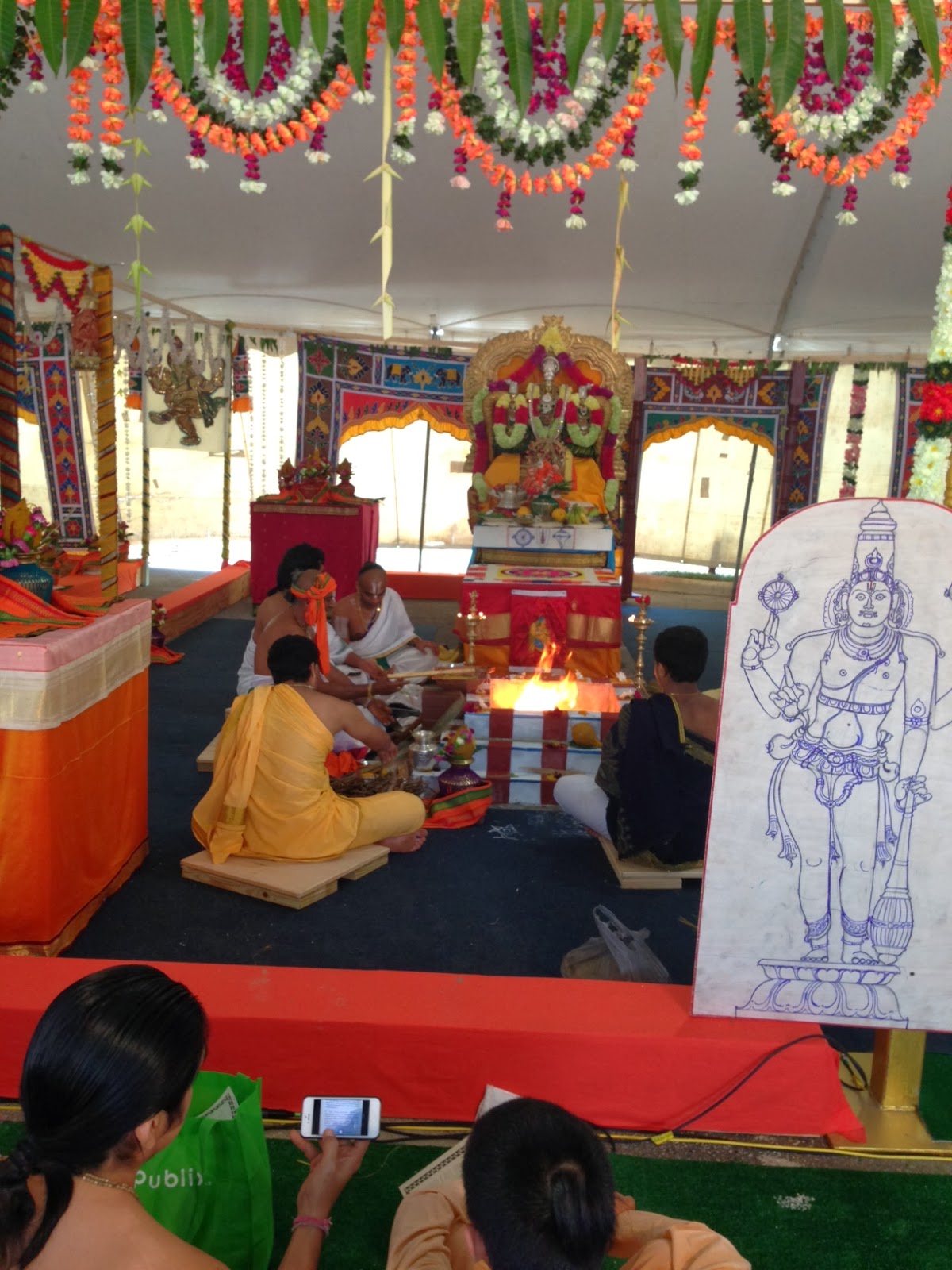
Gods must have been very satisfied with the Shiva Vishnu Temple of South Florida Kumbhabhishekam.  It was as if Varuna Bhagawan did another Kumbhabhishekam after the priests had done.  But Varuna was very careful not to impede any festivities by allowing the procession to finish and the devotees were safely inside the Temple or in the Fellowship hall or in one of those nicely erected tents.  The rain relented after the energy has been re-transferred to the Vigrahas – how about that?  How about those Garudas circling high above the Raja Gopurams exactly at the time of Kumbhabhishekam?  First there was this lonely Garuda and several others followed and they all vanished out of sight after the event.  It was indeed a heavenly blessing.

It is impossible to capture in words the three days of festivities, but I will try my best to provide my experiences.  To appreciate the entire event one needs to splice together several such viewpoints.  First, allow me to give a broad brushstroke of the festivities before going into details.  I would like to tip my hat to the organizers for going into minutest details and executing in grand style.  I would recommend that this should be documented as a model to be followed by other organizers.  A lot of meticulous planning went in to execute such a phenomenal event.  I have not seen Vaikuntam or Kailasham but the decorations took us pretty close.  Our priests were augmented by several visiting priests who were extremely knowledgeable; their Veda chanting was simply divine.  The religious committee volunteers worked tirelessly to help the priests.  How about those who took care of the parking and transportation?  They worked outdoor for hours together day after day with a permanent smile on their faces.  Thanks to the kids who volunteered at the shoe stand – not a single shoe was misplaced.  Thanksgiving weekend is famous in the US for food.  We were served with what seemed to be a never ending supply of tastiest South Indian delicacies.  We will talk about the cultural programs, especially the Yaksha Ganam program.  The music from Nadaswaram and Thavil gave stiff competition to the silk sarees in adding color to the festivities.  It was also a sort of reunion with those who used to live in South Florida and move on elsewhere.  It was real nice to see the South Florida kids who had gone off to college or work come back and participate in big numbers.  Speaking of kids let me digress a bit.

Dr. Vivek Murthy who grew up in our community has been nominated to be the Surgeon General by President Barak Obama.  When he showed up at the celebrations, there was a rustle in the crowd.  The kid who never fails to give me a hug will be the “Top Doc” in the country.  Jayanthi disputes “Vivek hugs me first”.  Right, whatever makes you happy!  Now we will be lucky to hug the body guard!  The entire South Florida community is proud of Vivek’s accomplishments and we all wish him the best in the confirmation process.  Vivek – you will be a fantastic Surgeon General.  Let us get back to function.

Nov 29, 2013 (Day 1) – We were engrossed in the religious activities during the first half of the day following the Ganapathi and Sudarshana Homams.  Simultaneously a whole lot of cultural activities were taking place in the Fellowship hall.  One needs to omnipresent to view everything that went on.  Later I saw snippets of the songs and dances by the talented South Florida community kids.  Great job every one.

In the evening, we settled down at the Fellowship hall to witness the program called Samarpanam.  It was nice to hear a combination of music and dance to live music by the Community teachers.  I especially enjoyed the song on Kamakshi when the singers were thoroughly synchronized – nice job by Madhu, Vasumathy mami, Hema, Bhagi, Viji with Sanjay on the violin and Dr. Ramakrishnan on the mridangam.  Noteworthy among the dances was the one on Andal by Shilpa Krishnan.  I enjoyed the injection of Bhagavad Gita slokas in the middle of Sadinchane.  It was refreshing to watch the choreographed dances to a few Pancha Rathna Krithis. Sri Srinivas and his students from Tampa added color to the music with his mridangam.

I wrote earlier about the energy transfer from the main deities on to the mirror.  Today the reversal of that process started.  The energy from the mirrors was transferred to Silver Kalasams filled with water.  Now the water became sanctified.  There is one Kalasam for each deity which were then taken in procession to the pooja tent for the homam and veda chanting the following day.

Nov 30, 2013 (Day 2) –
The Kalasams were connected to the Shiva Lingam and Sri Venkateshwara by what looked like a 300 feet long dharbha strand.  As the Veda mantras were chanted the energy flows back into the Moola Vigrahas through those strands.

It was a great fortune to sit among the learned Ritviks from the community and the priests and chant Veda mantras.  Thanks to Rajesh who is trying real hard to teach us.  We participated in the chant of Rudram, Chamakam, Purusha Suktam, Durga Suktam and Sri Suktam.  Chanting such divine Vedas in unison can open pathways to higher worlds.  It was a fantastic experience.

In the evening again we planted ourselves in the front row in the Fellowship hall.  We were able to see a few dances by advanced students.  Shilpa Sridhar captivated the audience with her beauty, grace and talent.

Yaksha Ganam – I had no expectation as I have never seen Yaksha Ganam performance before.  It is a combination of dance, drama and music.  There were only two main dancers with a supporting dancer.  Audiences were taken aback when the Krishna character made a grand entrance with really elaborate costume.  The story was about Shayamanthaka Mani.  This is a story where Bhagavatham meets Ramayanam.  Here is the brief:

Krishna was blamed for the loss of the gem called Shayamanthaka Mani.  Krishna goes to the forest in search of the gem where he finds the king was killed by a lion and the lion was also killed.  Following the footsteps that led to a cave Krishna finds Jambavan who had the gem.  After a lengthy dialogue between the two, a fight ensues.  As Jambavan began to lose the fight, he sees his Lord Rama in the form of Krishna.  Jambavan gets his daughter in marriage to Krishna and returns the Shayamthaka Mani.

There were just three characters in the dance drama but coupled with their story telling it made it look like every character came alive.  I wish I knew Kannada to understand the dialogue – well that will be my retirement project to learn that beautiful language.  The artist who acted as Krishna is a professor but he was clearly a professional.  The main actor was Jambavan came fully alive at the scene right after his daughter’s marriage and departure.  Both of them had impeccable rhythm and gait.  Live music accompaniment actually faded into the background which speaks volumes of their dancing prowess. 


Dec 1, 2013 (Day 3) – Today is the main Kumbhabhishekam day.  It was real nice to see all families together so early in the morning.  After the daily homam, the Utsava Vigrahas were taken in procession into the temple.  This was followed by the Kalasams taken by the priests into the Temple.  After that devotees got a chance to take the Kalasams around the temple in procession.  With the Nadaswaram music preceding the entire community walked around the temple.  Each Kalasam is filled with sanctified water with the energy of the respective deity.  The energy is then transferred back to the deities with appropriate mantras and abhishekam of the sanctified water.  For those who stayed outside the temple were still able to witness the Kalasa Abhishekam through the closed circuit television installed at several spots in the campus.  The arrangements were simply fantastic – no words can describe. 

For those readers who have not been to the Shiva Vishnu Temple of South Florida, the installed deities were Shiva as Ekambaranadeshwarar, Kamakshi, Ganesha, Iyyappan, Saraswathi, Valli-Devayani sametha Murugan, Chandikeshwara, Navagrahas, Nandi and Dwaja Sthambam from the Shiva parivar.  From the Vishnu parivar we have Lord Venkateshwara, Lakshmi, Andal, Krishna, Rama parivar, Hanuman, Vishwakshena, Garuda and Dwaja Sthambam.  As you can imagine it is quite an elaborate process to transfer the energies from this many deities and transfer back.  It is also very impressive that our Agama Shasthras were so clear in instructing how to do this maintenance process.  It is both practical and deep.  The function concluded in the evening with Kalayana Utsavam of Lord Shiva and Lord Venkateshwara. 


Jayanthi joins me to express our gratitude to Dr. Ramu Iyengar for his leadership and Sri Govindaraj for his execution and our thanks to every volunteer in every committee for a job well done.  Let me conclude with our namaskarams to all the priests who conducted the function effortlessly.