Wednesday, December 4, 2013

Nov/Dec 2013 Shiva Vishnu Temple Kumbhabhishekam

Gods must have been very satisfied with the Shiva Vishnu Temple of South Florida Kumbhabhishekam.  It was as if Varuna Bhagawan did another Kumbhabhishekam after the priests had done.  But Varuna was very careful not to impede any festivities by allowing the procession to finish and the devotees were safely inside the Temple or in the Fellowship hall or in one of those nicely erected tents.  The rain relented after the energy has been re-transferred to the Vigrahas – how about that?  How about those Garudas circling high above the Raja Gopurams exactly at the time of Kumbhabhishekam?  First there was this lonely Garuda and several others followed and they all vanished out of sight after the event.  It was indeed a heavenly blessing.

It is impossible to capture in words the three days of festivities, but I will try my best to provide my experiences.  To appreciate the entire event one needs to splice together several such viewpoints.  First, allow me to give a broad brushstroke of the festivities before going into details.  I would like to tip my hat to the organizers for going into minutest details and executing in grand style.  I would recommend that this should be documented as a model to be followed by other organizers.  A lot of meticulous planning went in to execute such a phenomenal event.  I have not seen Vaikuntam or Kailasham but the decorations took us pretty close.  Our priests were augmented by several visiting priests who were extremely knowledgeable; their Veda chanting was simply divine.  The religious committee volunteers worked tirelessly to help the priests.  How about those who took care of the parking and transportation?  They worked outdoor for hours together day after day with a permanent smile on their faces.  Thanks to the kids who volunteered at the shoe stand – not a single shoe was misplaced.  Thanksgiving weekend is famous in the US for food.  We were served with what seemed to be a never ending supply of tastiest South Indian delicacies.  We will talk about the cultural programs, especially the Yaksha Ganam program.  The music from Nadaswaram and Thavil gave stiff competition to the silk sarees in adding color to the festivities.  It was also a sort of reunion with those who used to live in South Florida and move on elsewhere.  It was real nice to see the South Florida kids who had gone off to college or work come back and participate in big numbers.  Speaking of kids let me digress a bit.

Dr. Vivek Murthy who grew up in our community has been nominated to be the Surgeon General by President Barak Obama.  When he showed up at the celebrations, there was a rustle in the crowd.  The kid who never fails to give me a hug will be the “Top Doc” in the country.  Jayanthi disputes “Vivek hugs me first”.  Right, whatever makes you happy!  Now we will be lucky to hug the body guard!  The entire South Florida community is proud of Vivek’s accomplishments and we all wish him the best in the confirmation process.  Vivek – you will be a fantastic Surgeon General.  Let us get back to function.

Nov 29, 2013 (Day 1) – We were engrossed in the religious activities during the first half of the day following the Ganapathi and Sudarshana Homams.  Simultaneously a whole lot of cultural activities were taking place in the Fellowship hall.  One needs to omnipresent to view everything that went on.  Later I saw snippets of the songs and dances by the talented South Florida community kids.  Great job every one.

In the evening, we settled down at the Fellowship hall to witness the program called Samarpanam.  It was nice to hear a combination of music and dance to live music by the Community teachers.  I especially enjoyed the song on Kamakshi when the singers were thoroughly synchronized – nice job by Madhu, Vasumathy mami, Hema, Bhagi, Viji with Sanjay on the violin and Dr. Ramakrishnan on the mridangam.  Noteworthy among the dances was the one on Andal by Shilpa Krishnan.  I enjoyed the injection of Bhagavad Gita slokas in the middle of Sadinchane.  It was refreshing to watch the choreographed dances to a few Pancha Rathna Krithis. Sri Srinivas and his students from Tampa added color to the music with his mridangam.
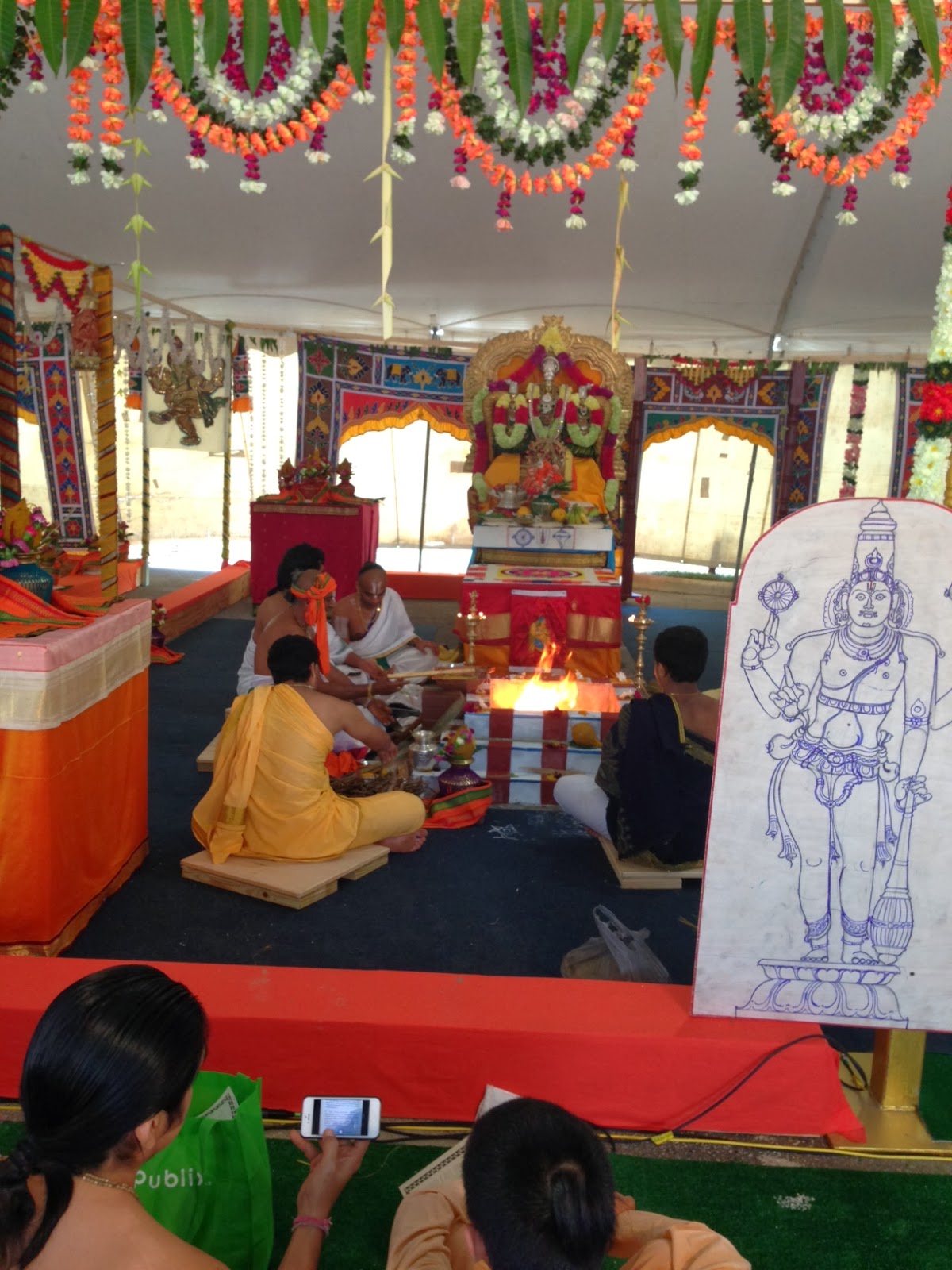
I wrote earlier about the energy transfer from the main deities on to the mirror.  Today the reversal of that process started.  The energy from the mirrors was transferred to Silver Kalasams filled with water.  Now the water became sanctified.  There is one Kalasam for each deity which were then taken in procession to the pooja tent for the homam and veda chanting the following day.

Nov 30, 2013 (Day 2) –
The Kalasams were connected to the Shiva Lingam and Sri Venkateshwara by what looked like a 300 feet long dharbha strand.  As the Veda mantras were chanted the energy flows back into the Moola Vigrahas through those strands.

It was a great fortune to sit among the learned Ritviks from the community and the priests and chant Veda mantras.  Thanks to Rajesh who is trying real hard to teach us.  We participated in the chant of Rudram, Chamakam, Purusha Suktam, Durga Suktam and Sri Suktam.  Chanting such divine Vedas in unison can open pathways to higher worlds.  It was a fantastic experience.

In the evening again we planted ourselves in the front row in the Fellowship hall.  We were able to see a few dances by advanced students.  Shilpa Sridhar captivated the audience with her beauty, grace and talent.

Yaksha Ganam – I had no expectation as I have never seen Yaksha Ganam performance before.  It is a combination of dance, drama and music.  There were only two main dancers with a supporting dancer.  Audiences were taken aback when the Krishna character made a grand entrance with really elaborate costume.  The story was about Shayamanthaka Mani.  This is a story where Bhagavatham meets Ramayanam.  Here is the brief:

Krishna was blamed for the loss of the gem called Shayamanthaka Mani.  Krishna goes to the forest in search of the gem where he finds the king was killed by a lion and the lion was also killed.  Following the footsteps that led to a cave Krishna finds Jambavan who had the gem.  After a lengthy dialogue between the two, a fight ensues.  As Jambavan began to lose the fight, he sees his Lord Rama in the form of Krishna.  Jambavan gets his daughter in marriage to Krishna and returns the Shayamthaka Mani.

There were just three characters in the dance drama but coupled with their story telling it made it look like every character came alive.  I wish I knew Kannada to understand the dialogue – well that will be my retirement project to learn that beautiful language.  The artist who acted as Krishna is a professor but he was clearly a professional.  The main actor was Jambavan came fully alive at the scene right after his daughter’s marriage and departure.  Both of them had impeccable rhythm and gait.  Live music accompaniment actually faded into the background which speaks volumes of their dancing prowess. 


Dec 1, 2013 (Day 3) – Today is the main Kumbhabhishekam day.  It was real nice to see all families together so early in the morning.  After the daily homam, the Utsava Vigrahas were taken in procession into the temple.  This was followed by the Kalasams taken by the priests into the Temple.  After that devotees got a chance to take the Kalasams around the temple in procession.  With the Nadaswaram music preceding the entire community walked around the temple.  Each Kalasam is filled with sanctified water with the energy of the respective deity.  The energy is then transferred back to the deities with appropriate mantras and abhishekam of the sanctified water.  For those who stayed outside the temple were still able to witness the Kalasa Abhishekam through the closed circuit television installed at several spots in the campus.  The arrangements were simply fantastic – no words can describe. 

For those readers who have not been to the Shiva Vishnu Temple of South Florida, the installed deities were Shiva as Ekambaranadeshwarar, Kamakshi, Ganesha, Iyyappan, Saraswathi, Valli-Devayani sametha Murugan, Chandikeshwara, Navagrahas, Nandi and Dwaja Sthambam from the Shiva parivar.  From the Vishnu parivar we have Lord Venkateshwara, Lakshmi, Andal, Krishna, Rama parivar, Hanuman, Vishwakshena, Garuda and Dwaja Sthambam.  As you can imagine it is quite an elaborate process to transfer the energies from this many deities and transfer back.  It is also very impressive that our Agama Shasthras were so clear in instructing how to do this maintenance process.  It is both practical and deep.  The function concluded in the evening with Kalayana Utsavam of Lord Shiva and Lord Venkateshwara. 


Jayanthi joins me to express our gratitude to Dr. Ramu Iyengar for his leadership and Sri Govindaraj for his execution and our thanks to every volunteer in every committee for a job well done.  Let me conclude with our namaskarams to all the priests who conducted the function effortlessly.

Monday, November 11, 2013

2013 Nov - Nadaswaram Concert by Nakenthiran and Party

A long time ago, I heard a joke about why Nadaswaram is played in marriages.  When the “getti melam” is played during the time of tying the knot the decibel level of the instrument is so high making it hard for the couple to have second thoughts.  The music generated by the Nadaswaram and Thavil simply carries above the general chatter of the people attending weddings it will even drown out any harmful family gossip. 

For me, sitting in the front row for the Nadaswaram concert, forget about the second thoughts I did not even have first thoughts.  The music simply drove away all the thoughts allowing us to experience just the presence which is beyond thoughts.  For that, we are grateful to Mr. Nakenthiran and party for a sumptuous concert.  That could be the reason though many of us complained about the high volume but stayed through the concert.  Presence must be addicting.  Allow me to digress a bit and we will pick up from here shortly.

Our beloved singer within our community received a coveted “Aasthana Vidwan” title from Kanchi Sankaracharya recently.  It is none other than Sri Madhu Venkatesh Chandrasekar.  Well deserved title for someone who is innately talented, well trained and has worked extremely hard to achieve great heights such as this in his music career.  Jayanthi joins me in wishing you enormous success in the field of music and every aspect of life.  The entire South Florida community is very proud of having Sri Madhu in our midst.  Congratulations to his family as well for providing the support.  Nice job. 

Shiva Vishnu temple Kumbhabhishekam activities are happening around the clock.  It will culminate during the Thanksgiving weekend this year.  Along the way, we have some unique opportunities to experience a few rare events.  It is our strong belief that the Moola vigrahas inside the inner sanctum have the energy of their respective Gods invoked in them when the Temple is first built.  In the case of our temple, Sri Savyasachi Swamigal came to do the initial invocation or Prana Prathista at the time of the first Kumbhabhishekam.  Over the years through the chanting of Vedas, abhishekams, poojas and prayer of thousands of devotees the Sannidhyam or divinity has grown.  Now, it has been 12-years and it is time to renew the temple or do the Jeernodharanam followed by another Kumbhabhishekam.  The question is what to do about the energy inside these Moola Vigrahas?  During the recent Balalayam function, this energy was  transferred on to mirrors and saved for the next two weeks.  The energy will be transferred back during the Kumbhabhishekam.  It was interesting that strands of darbhai, a form of sawgrass, are used for this purpose.  One may ask – is this all hocus pocus?  Well, if you believe there is energy in those vigrahas then it can surely be transferred to another object and transferred back.  If you can believe thin strands of fiber optics can carry thousands of phone calls then surely darbhai can be the conduit to enable the transfer.  Let me leave it at that and allow people with more knowledge to carry on the dialogue.  Let us get back to the concert.

I must admit I enjoyed the Carnatic music part in the first half of the concert more than the film songs that followed.  But everyone enjoys songs from the evergreen film like Konjum Salangai and Thillana Mohanambal.

·    Vathapi Ganapathim in Hamsadhwani – started the concert powerfully.  The sahithyam part was done very well.  Swaras could have been stronger but overall a powerful rendition

·    Aravinda Lochana in Needimathi – took many of us for a loop in guessing this ragam.  Glided us through the song beautifully.

·    Ninuvina in Navarasa Kanada – when the alapana started I thought the song was going to be Papanasam Sivan’s “Naan oru vilaiyatt bommaiya”.  Let me put in the request for the next time.  Excellent alapana and very nice rendition of the song.  Thoroughly enjoyed it.

·    Ever popular “Kurai Onrum Illai” in Raga Malika – audience was in a music-high at this point.  Now the film song section:

·    Singara velane deva – abheri.  Probably an all time favorites among nadaswaram fans.  A difficult song with very intricate gamakams.  Took us back 50-years to this film era.  Nice.  I am going to list the film songs played so you can gain an appreciation (at least the Tamils among the readers) for the breadth and depth of the team’s knowledge of film music.

·    Thunbam nergaiyil (in Desh), Kannodu kanbathellam, Ponnonru kanden

·    Maraindirundu parkum (in shanmuga priya), Nalamdana, English note by madurai mani – great to hear Thillana Mohanambal songs back to back

·    Aiyyayyayyo anandame, Unnai kanaada (from Vishwaroopam), Nee oru kaadal sangeetham, Then sindude vanam, ENNa paravai siragadithu, Pakkathile kanni pennirukku (from padikkada medhai), Vinnodum mugilodum, Konja neram, Thakita thadhimi (from salangai oli), Innum konja neram?? – kumki, Amudhai pozhiyum nilave, Thaazhaiyaan poo mudichu, Povoma urgolam - chinna thambi, Radhaiyin nenjame, Uruguthe maruguthe

·    Nenjukkulle unnai from recent movie Kadal.  Responded to on the spot request from the audience.  A very difficult song to sing or play.  I thought the song was simplified and played in Nadaswaram.  Good attempt.

·    Thillana – from where else?  Thillana from Thillana Mohanambal, of course. 

Thanks to Ilangai Tamizh Manram and Sri Balasubramanian from arranging the concert.

Wednesday, August 14, 2013

2013 Aug - Dance Recital by Shilpa Sridhar

Dancing Dynasty

Shilpa Sridhar, who is a darling of our South Florida community, gave a fantastic dance recital on Aug 11, 2013 at the River of Grass Susan B Katz Theater. 

Let us set aside the dance part a bit and listen to the thank you speech again from Shilpa.  She did not just stop at thanking her parents for everything they have given.  Shilpa said she hopes to take care of them someday like she is being taken care.  That was a very inspiring statement for someone who just finished her high school.  It was nice to see mother-daughter team function also as a Guru-Sishya team.  Bringing up a child is tough enough, in addition bringing out the artistic talent is even more difficult – great job by Sangeetha Sridhar.  Jayanthi joins me in blessing Shilpa for the dancing dynasty to continue.  Congrats to the Sridhar family.

We have known Shilpa from her birth so obviously I will be a little biased.  I tried to set that aside and look at her dance from an outsider viewpoint to the best of by ability.  Congratulations to Shilpa as she has truly developed her “dancer personality”.  It is one thing to repeat what your guru has taught but it is a whole another thing to bring out your own personality into it.  That’s when a dancer truly begins to blossom in her art form and chalks a course for herself.  It is wonderful that she has captured that essence and I think those who witnessed will agree.  Speaking for South Florida community I would request Shilpa to give a solo performance at least once a year.  In addition, in during her undergraduate years at the University of Florida I am sure she will showcase her talent.  We are very proud that Shilpa is from our community.  We wish you the best in your life.

Pushpanjali and Jathiswaram – A striking beginning to the program.  Jathiswaram was in Ragamalika which made it look like we were witnessing several Jathiswarams back to back.  The ease with which Shilpa moved about on stage and her graceful fluid movements gave life to the music.  Her sense of rhythm was evident.  This set the tone for the program to come.

Varnam in Shiva Shakthi and Shivaranjani in Adi – here three generations were at work in this number.  Shilpa’s grandmother Smt. Vasumathy Swamy is truly a gifted Tamil poet.  She has composed many songs in the past and they have been set to music and choreographed into dance numbers.  This one tops it all – great job, Maami.  This Varnam is on Ardhanarishvara a celestial union of Shiva and Parvathi as one – symbolizes that male-female principles are inseparable.  This Varnam was written specifically for this program.  It was a 40-45 min piece demonstrating Shilpa’s mastery over various faculties of Bharatha Nrithyam and endurance.  There were a lot of scope for showing the bhavams especially the power of Shiva and the grace of Parvathi.  It culminated in bringing the two together with Shilpa depicting Shiva on her right half and Parvathi on her left.  The raga choice was also fantastic here in bringing out the true feelings of the song which was powerfully rendered by the orchestra making it a divine experience.

Illai, Illai in Ragamalika/Adi – Some of you may have heard the Hindi Bhajan composed by Sur Das called “Mai Nahi Makhan Khayo” popularized by Anup Jalota in recent times.  Inspired by that, this song takes two popular krithis of Oothukkadu “Thaya Yashoda” and “Illai Illai” and blends it into one number.  Krishna lies through the song to get favors from Yashoda and finally delivers the punch line that every complaint she heard was in fact true by adding “Poyye Illai” at the end.  Very similar to Sur Das’s clever punch line of “Mai Ne hi Makhan Khayo” meaning “I was the one who ate the butter”.  Now, let your imagination go on how Shilpa would have danced for this song.  Any song on Krishna is always a favorite of audiences of all ages.  Lot of happiness, humor and grace were presented in this song.

Maa Mayura in Bilahari/Adi – a catchy tune in a ragam that is favorite for many and well done by the orchestra.  Song depicts Lord Muruga riding on his beautiful peacock to come and bless the dancer.  Nice depiction of festivities and devotion to Muruga and graceful steps with Kaavadi. 

Sundara Kaandam in Ragamalika/Adi – Shilpa depicted the stories of Hanuman crossing the sea to find Sita in the Ashoka Vanam in Lanka.  Shilpa actually brought out those characters from within.  We all felt like flying with Hanuman and feeling the sorrow of Sita staying alone in Ravana’s land.  That shows the maturity of the dancer as she becomes the character she is depicting.  Nice.

Drupad in Purvi/Rupakam – well rendered with speed and agility.


Sunday, August 4, 2013

Aug 2013 - Bharatha Natyam Arangetram by Bhavika, Aneesha and Shalini

A feast for eyes and ears

Bharatha Natyam Arangetram of Aneesha Balachandar, Bhavika Shah and Shalini Chandar successfully took place on Aug 3, 2013 at the beautiful Miniaci center of Performing Arts in Ft. Lauderdale, Florida.

Having multiple dancers in a debut performance has some advantages and challenges.  This allows a lot more scope for creative choreography which was nicely taken advantage by their teacher, Aparna Matange.  There is a huge pressure on the dancers to be in lock step with each other as even a slight miss can be picked by even untrained audience.  Kudos to the dancers as their years of training have paid off.  A lot of credit goes to Aparna for imparting the thalam knowledge to her disciples.  Overall, the performance was a real treat along with the musical ensemble.  Each dancer is very capable and I hope they stretch themselves to the challenge of giving solo performances in the future.  Jayanthi joins me in congratulating Shalini, Bhavika and Aneesha.

Before going to the song-by-song details I would like to have a word with you about the MCs, Sangeetha Ramkumar and Jigna Shah.  It is wonderful to have MCs who are accomplished dancers themselves.  Their explanation before each song with abhinaya was extremely educational.  They were both picture of grace and beauty on stage.  We have all seen this done by dancer themselves on occasion but this format is surely refreshing and thank you for giving us a unique experience.

Ganesha Stuthi – when the singer and mridangist started the evening with a beautiful rendering of a song on Ganesha we all knew this is going to be an enjoyable evening.  In Tamil we say “Kutchery Kalai Kattidithu” meaning the program is going to be wonderful.  Mridangam usually sets the tempo of a dance program and Sri Shankaranarayan set it beautifully.  The well trained voice of the singer, Bhavana Pradumna, was well suited for dance with a bit of huskiness in it and the mridangist was an experienced hand.  On the violin was our local maestro, Sanjay Chandran and on the Flute was Sreekrishna Pasumarthy.  They added color to the concert.  Nice job, overall.

Shloka and Alaripu – All our programs start with a dance seeking the blessings from Guru, God and the audience.  Alaripu is a warm up for the upcoming performance.  Also gave a peek into the choreography we are about to witness – nice touch.

Jatiswaram in Raga Hamsanandi/Rupaka talam – Aparna had a very well trained voice for rendering the Jati’s, it is no wonder as she is a trained singer as well.  Nice dance sequences individually and collectively.  It was like watching a kaleidoscope bursting in front of our eyes as the dancers moved in rhythmic patterns in their rich costumes.  The synchronization of the thalam among the dancers was pleasing.

Gajavadana in Sriranjani/Aadi – This was a solo performance by Aneesha, who was very graceful.  Her hard work through the years of training showed.

Varnam in Poorvi Kalyani/Aadi – As always, I enjoyed Sanjay’s rendition of Poorvi Kalyani on the Violin.  His intro piece to the song was nice and the singing by Bhavana was wonderful.  Varnam is usually the most challenging piece in any Arangetram as it tests every aspect of the dance – pure dance form, sancharis or story-telling, abhinya or acting and bhavam or expressions.  Varnam also tests your mettle as it usually goes on for about 40-45 min.  In a shared Arangetram the endurance test is lost a little as the choreography has to allow for each to showcase their individual talent.  But I can tell you that each one is capable of taking on the challenge of a solo performance.  I am hoping to see that very soon.

Pancharatna Kriti – Jagadananda in Natai/Aadi – very good song selection.  This is a well known krithi, loved by all music lovers, but first time for me witnessing as a dance number.   Choreography again is done well and executed beautifully by all the dancers.

Enna Thavam in Kapi/Aadi – another song composed by Papanasam Sivan Krithi.  Shalini gave a solo performance for this song.  Shalini had grace and beautiful expressions.  She beautifully acted out the part where Krishna was tied to a barrel and releasing himself.  Good job.

Jakkinidaru in Shankarabharaman/Aadi – well done

Yaro Ivar Yaro in Bhairavi/Aadi – a beautiful slow number with a lot of scope for abhinaya and bhavam.  Bhavika as a solo performer did a very nice job displaying Seetha’s mind as she watches Rama in procession through the streets of Mithila.  There were some light moments in the performance which was very enjoyable.

Thillana in Brindavana Saranga/Aadi – nice brisk dance with intricate footwork and poses.  Having three dancers again gave a lot of scope for unique choreography well taken advantage by Aparna.    

Nice performance by Shalini, Bhavika and Aneesha.  Accept our blessings for you to grow and achieve greatness in your life.  Having been trained in one of the greatest art forms in the world – keep that passion alive through the rest of your life.  You will never know when it will come in handy.  Keep up the great work.

Sunday, November 4, 2012

2012 Nov - Pantula Rama Vocal Concert

Vocal – Smt. Pantula Rama, Violin – Sri MSN Murthy, Mridangam – Sri Thanjavoore Murugabhoopathy

Exciting times in South Florida – just finished Navarathri looking forward to Deepavali followed by Presidential elections in which Florida is one of the swing states.  No one can take Florida for granted neither the politicians nor the artists.  They all need to work hard to gain our favor.  Whoever wins the general elections in the next couple days, let hope and pray that the next President will show leadership in bringing the divided country together.  The stalemate between congress and senate needs to end.  They need to steer us away from this menacing economic cliff and move the world towards safety and progress.  Congressmen, Senators and the President – you want our votes to lead us.  Then lead – pure and simple. 

Jayanthi joins me in thanking Mrs.  Bhagi Sahasranaman for her tireless work along with the cultural committee members for the past four years.  Bhagi has done a great job in delivering quality concerts and has served our community well.  Alright, let us go to the concert.

Nice to see a real life couple on stage – Here the husband played the support role for his wife as the main singer.  Just like the government there were three parts to the ensemble on stage.  Though individually talented they did take a little while to come together.  The main piece in Kalyani was magnificent.  I have not heard a thani in Mishra Chapu in a long time.  Let us discuss song by song.
Vallabha Nayaka in Begada/Rupakam – very short but crisp alapana.  Smt Rama captivated the audience with her rich and powerful voice.  She was very comfortable with the ragam gliding through the ups and downs.  She delivered swarams masterfully.

Endaro Mahanubhava in Sri/Adi – I don’t know about the rest of the audience but to me this was a disappointing delivery.  Being one of the Pancharathna krithis everyone knew the song well including many in the audience.  Anticipation is ok but the supporting violinist should not get ahead of the singer.  It seemed like the singer was the supporting artist in many places – not enjoyable.
Mudda Momu in Suriyagantham/Adi (double branched) – many in the audience including me were not familiar with the ragam and we could have used a short version of the Alapana.  When the song started the mood changed a little.  I liked the kalpana swaram part where the violinist could not get ahead of the singer. 

Sangeetha Gnanamu in Dhanyasi – very nice delivery.  Artists were beginning to come together.
Thunai Purindarul in Varamu/Adi – good change of language, I am biased towards Tamil songs.  Very peppy number and she was very comfortable with the song and also the language.  Violin was powerful, niravals were enjoyable and swaras flew nicely.  All in all, a good delivery

Main Piece, Dalli Innu Nera Nammi in Kalyani/Mishra Chapu – paisa vasool.  Alapana was beautifully structured and tastefully decorated with brigas.  Kalyani is a majestic raga.  I think the audience would have enjoyed a longer alapana.  Violin solo alapana was fantastic.  Artist showed a lot of bhavam in delivering the song, swaras were really good.  Thani in Mishra Chapu, my favorite talam, was beautifully done.  The mridangam sounded really soft.  Great job, everybody.
Dharma Shravana in Durga/Adi – excellent delivery

Charanu Charanu in Madhupriya – nice flowy number
Krishna Nee Begana Baro in Yamuna Kalyani/Mishra Chapu – let me add my thanks to whoever requested this song.  Very elegantly executed and captivated the audience.

Thillana in Dhanasri/Adi – enjoyable song, especially the mridangam was simply superb.
I have to admit that I normally tune out during the Mangalam.  But Smt Rama’s Mangalam was brilliant. 

Concert had a rocky start moved to a nice crescendo during the main piece and ended powerfully making us to want more.  Job well done.

Sunday, October 28, 2012

2012 Sep/Oct Concerts by TVS, OST and Lalgudi Vijayalakshmi


Vocal – Sri TV Sankaranarayanan, Violin – Sri VVS Murari, Mridangam – Sri Thiruvaroor Bhakthavatsalam
In my writing career this is certainly a high point to have the privilege of writing about the concert by the well respected TV Sankaranarayanan.  Musical heritage is not a guarantee of talent but in case of Sangeetha Kalanidhi Sri TVS it is certainly true – Sri TVS is Madurai Mani Iyer’s nephew.  Let us go straight to the concert.

It is certainly one of the best concerts I have listened to in several years.  First let me applaud the sound technicians who did some innovations for this concert.  I don’t know how they got the normally finicky musicians to agree to this significant change.  The monitor speaker was set up behind the artists so they could hear exactly what the audience heard.  The sound was balanced so perfectly it made the entire concert a great treat.  Even the artists mentioned about how great the set up was and they were going to try and use this method in future concerts.  Kudos, great job Arun and Dr. Ramakrishnan!
Vigneshwara Subha in Arabi/Rupakam – great start to the concert in a peppy ragam that set the tone for the entire concert.  Fantastic voice dynamics, Sri TVS owned the stage.  The swaras were borrowed from Pancharathna Krithi initially and then skillfully shifted away.  Just like one can expect in any TVS concert swaras started pouring.  Both violinist and the mridangist made their mark early in the concert.

Subrahmanya Rakshitham in Suddha Dhanyasi/Adi – very energetic song in a popular ragam; several more bushels of swarams;  Bhakthavathsalam on the mridangam knew he had many fans in the audience and did not disappoint them.  He showed tremendous speed and clean strokes to match the gamakams from the singer.  Borderlines on being a little theatric but the audience just loved it.
Ravichandra Budha in Atana – short and sweet

Guruvayoorappa in Chakravaham/Adi – Nice change of pace with alapana; soulful rendition.  Mridangam sound was a bit too loud
Sarasa Samadhana in Kapi Narayani/Adi – evergreen song, fast number and everyone’s favorite popularized by his uncle Madurai Mani Iyer.  Niraval was remarkable going from soft and slow to fast and furious.  Took a small song and elaborated with niravals and swaras showing his mastery over the art

Venkataramana in Lathangi/Rupakam – Elaborate alapana with some tastefully mixed Hindustani phrases.  My father used to say one should show bhakti bhavam even in alapana by blending in words like “hari ….”, “hara …” instead of meaningless “Ta da ri na”.  Sri TVS is one of the few to still follow that age old tradition.  Violin had done a great job till this point but the alapana here was a bit lackluster.  Could have selected a different ragam for the afternoon concert. 
Main Piece – Intha Sowkya Manine in Kapi/double branched Adi – I thought it was rare to hear Kapi as the ragam for the main piece.  Alapana was powerful, he quickly got through the words and got to the swaras.  The swara spigot opened at full speed.  Great rendition.

Thani – had to make a special mention of Sri Bhakthavathsalam Sir’s Thani.  People come with certain expectations of energy, speed and combination of strokes.  He did not disappoint.  Absolute magic, fantastic Thani that made the audience totally engaged.
RTP in Mohanam/Tisra Tiruputai – thanam part was beautifully done, wow, what command over the ragam.  Violinist came to his full height.  The ragamalika section was very entertaining with popular ragams like Hindolam, Shyama, Bhageshwari.

Eppovaruvaro in Jonpuri preceded by a Virutham – gamakams were fantastic
The concert ended with the ever popular Madurai Mani’s Note, a toe tapping number.  The energy was maintained from the beginning to the very end. 

None of us wanted the concert to end that included the artists.  When we all went up to the artists to mention how well they sang and played for us, Sri TVS humbly said it is because you were great rasikas - please come back.
Vocal – Sri OS Thyagarajan, Violin – Ranjani Ramakrishnan, Mridangam – Dr. S. Ramakrishnan

It was a traditional concert with the pentatonic raga medley (5-note ragas) being the highlight of the concert in Hindolam, Mohanam, Suddha Saveri and Hamsa Nadham.  He moved from ragam to ragam without giving a chance for a applause in between.  He also showed a unique capability in displaying Ragam-in-Ragam. – he brought out Suddha Dhanyasi within Kalyani Ragam by doing a Graha Bhedam or Swara Bhedam.  This is a skill that is very difficult to master, only a few will even attempt.  It seemed like the artist was holding himself back.  An open throated singing would have made the concert even more enjoyable.

Here is the write-up for the concert from Prasanna Padmanabhan:

He started off with Dikshitar's Vatapi Ganapathim followed by a small but brisk kalpana swaram. This was followed by Tyagaraja's beautiful Evarani nirNayincirirA in the ragam Devamrithavarshini (or also Nadachintamani in some circles), a very close cousin of Karaharapriya. 
 
The next was Samagana Lolane in Hindolam. Ranjani showed great dexterity on the violin in the aalapanai. OST cleverly exposed the swaraksharam built into the song (Sa Ma Ga...) in the kalpana swaram.

Without any gap, he started Evarura Ninuvina in Mohanam, Korvais were beautiful crafted by Ranjani in the kalpana swaram. Again, without any gap, he started a brisk paced song in Sudhasaveri called Kala Karane Mela Raghave, which also included a fast Kalpana swaram. It felt almost like a singing marathon when he quickly moved on to Bantureethi in Hamsanadham, once again, without any gap, which I felt he could have gone a little slower and taken the time to bring out the depth of the ragam. I also saw that because there wasn't a lot of breathing room between songs, Dr Ramakrishnan was forced to fine tune the mridangam on the fly although he seemed to do it quite seamlessly!

Then there was the main piece in Kalyani - Tyagaraja's Ethavunara. In the elaborate aalapanai, he was demonstrating "swara bedam". The audience was completely wired to Dr Ramakrishnan's tani. 

He entertained the audience's request for Sabapathi (although usually Abhogi is sung earlier in the concert) - it was a nice treat to my ears. Then there was Muruga (Saveri), followed by Pashyati and a Tillana in the ragam Sankarabharanam (sung in tishram). He finished with Nadupai in Madhyamavati starting with the anupallavi first!

Overall I enjoyed the concert. While I felt he could have gone a little slower in some places, it was well rooted in a refreshingly traditional, old-school style and quite authentic which you don't see very often these days. 

 
Violin – Vijayalakshmi, Mridangam – Bangalore Praveen, Tabla – Nitin Mitta

Comments from Bhavani Nirmal – She chose all lively ragas and elevated the mood of the audience. Normally in writing about a dance performance we talk of "Konjum chalangai" I can describe today's concert as "Konjum violin" The melody and her handling of the ragas and swaras are ringing in my ears.  The thani between the mridangam and tabla players was masterful and engaged our attention totally.  I didn't see a single person treating it as a coffee break because we were totally absorbed by the performance. 

Let me add my comments but it may not be as flowery.  Frankly, I had low expectation for this concert.  But Smt. Vijayalakshmi has blown that away with her sheer violin prowess.  But I have a fundamental question about the concert – what is the true reason for adding tabla to the concert?  The violinist did not add Hindustani touches anywhere in the concert which could have brought out the beauty with the tabla accompaniment.  She just powered through with her traditional Carnatic style playing.  Other than creating a balanced appearance on the stage with the violinist in the middle with mridangam and tabla players on either side, in my view the tabla did not add much to the concert.

Varnam in Garudadhwani – a clever choice, with this peppy number she instantly connected with the audience.  She had a very good command over the instrument

Mamalu Sadha in Kanada/Rupakam – very nice, clean rendition in another peppy ragam.  I had difficulty accepting tabla in a Carnatic concert. 

Arul Seyya Vendum in Rasikapriya/Adi – soulful alapana, very nice touches with her gamakams.  Soft mridangam was very enjoyable

Mati Mati in Mohanam/Mishra Chapu – Smt. Viji rose to her full height in the alapana,  Swaras with alternating mridangam and tabla was an enjoyable section of the song.  Derailed a bit in second speed.   Could have tastefully injected some Hindustani Bhupali touches

Amritha Vahini – energetic song with fantastic control of the bow even at top speed

Hechariga Ra Ra in Edukula Kambodhi/Kanda Chapu – another peppy ragam that captivated the audience.  Well executed gamakams and she glided through the swaras

Kamalamba Bhajare in Kalyani/Adi – favorite of many in the audience.  Alapana was very clean.  But in a long song holding the audience was tough.  I am finally getting used to the Tabla – actually enjoyed it. 

Thani – I agree with Bhavani, the Thani was simply amazing.  The back and forth between the two percussion players was done in misra kuraippu – 7-count inside the 8 beat Adi talam.  This allowed the luxury of a gap of one count making the give and take very easy and enjoyable at the same time.  The energy, speed and stroke combinations were brilliant.

Kaliyuga Varadan in Brindavana Saranga/Adi - Nice

Baro Krishnayya – very enjoyable rendition

Akhilandeshwari in Dwijavanthi/Adi – beautifully executed with very nice touches. 

Thillana in Behag/Adi Tisra Nadai – very good audience involvement, well done.

Sunday, July 22, 2012

Arangetram by Nitya Ramalingam

The Bharathanrityam Arangetram of Nitya Ramalingam was a delightful treat to the knowledgeable South Florida audience on Jul 14, 2012 at the Sunrise Civic Center in Sunrise, Florida.  It was our privilege and pleasure to have the presence of Sangeetha Kalanidhi Dr. Trichy Sankaran.  In addition to being present he has also reduced my workload by reviewing the performance as well.

(Transcription of Sangeetha Kalanidhi Dr. Trichy Sankaran's Speech)
From time immemorial, dance has been an important part of ritual in Indian tradition.  Bharatanatyam is grounded in bhakti besides other sentiments.  In fact bhakti is at the centre of all the arts in India.  Our music and dance are two important offerings to god.  As one gets involved in the art, with greater dedication, one can experience throughout the hours of dancing a greater joy, a complete well-being, especially when music and dance mingle indistinguishably.

Music and dance or any fine art for that matter, knows no barriers.  Although the roots of Bharatanatyam run deep into the culture of South India, it has a universal domain and acclaim.  So it is not surprising that Bharatanatyam is being taught and performed everywhere around the globe.  We have many dance systems, styles and banis.  The very life-breath of art is unity in diversity.  This is what I see in many of our dance systems.  I express my sincere admiration for all these systems, be it Bharatanatyam, Kathakali, Kathak, Manipuri, Odissi or Kuchipudi for which the divine god-centered aspect is common.

Tradition is a stronger force.  We must use tradition as a basis to develop art; otherwise the art will decline and disappear.  In this respect, innovations are an integral part of any great art.  Innovations and modifications are taking place all the time and our music and dance are evolving and changing.  But we want to make sure that these changes take place within the boundaries of tradition.  Dr. Padma Subramaniam, a dance legend herself is known for her unique style of dancing based on Natyasastra, under whom Smt. Sangita Sridhar has received her training in Dance.  It is quite evident in today’s arangetram of Kumari Nithya, how well she has trained her student and how wonderful a teacher she is.  The blending of Vazhuvoor Bani and Padma Subramanyam’s style showed beautifully in today’s performance.  Music is integral to a dance performance; particularly vocal music where lyrics become important for the portrayal of abhinaya and this has been followed very faithfully in today’s performance. Her choreography was excellent.  The Nattuvangam, the very essence and the bedrock of the whole concept of dancing performed by Sangita Sridhar herself showed her versatility on this particular aspect as well.

About the artists: 

Vocal:  Sudev Warriar, who is the disciple of Padmavibushan Dr. M. Balamurali Krishna, has enthralled us with his captivating music.  His music reflects on the experience he has gained over the years by singing for eminent dancers as well as his collaborative work with famous playback singers such as Dr. J. Yesudas, Sri S.P. Balasubramaniam and others.

Mrdangam:  On the mrdangam, we have Sri Sudhaman who demonstrated his excellent skill in accompanying the dance.  He has performed with eminent dancers like Dr. Padma Subramaniam, Chitra Viswesvaran, and others besides performing in regular Carnatic recitals.  His father K.N.S. Namboodhri was my disciple and I have known Sudhaman very well on a personal basis.  I wish him well in the future.

Flute:  On the flute, Sri Chitoor Pathanjali beautifully demonstrated his skills.  He comes from a family of musicians.  I have known and performed with his grandfather Sri. Chitoor Gopalakrishnan.  His melodious accompaniment was quite delightful.  My blessings and best wishes to all the artists on stage.

It was quite graceful to see Nitya Ramalingham dance and make her debut on this auspicious occasion at a young age.  Her coordination of feet and body movements to the rhythms of jatis, facial expressions and mudras in abhinaya, dancing to the tirmanams etc. were excellent.  Her training in vocal music, am sure, must have helped her dancing in many ways.  As I pointed out earlier, knowledge of vocal music is essential for the dancer as well as accompanying artists.  No wonder for a bright and brilliant girl like Nitya who is an honors students holding top rank in her high school studies, the art of dancing, singing, and piano playing must have come naturally, of course with arduous practice.  Once again, my hearty congratulations to Nitya for her successful debut.  

Arts are tremendous source of inspiration for any culture.  Arts and cultures dialogue in a number of different ways.  I am very glad to see teachers like Sangita Sridhar helping the community to get involved in learning the fine arts.  Similarly Dr. Ramakrishnan has been training many students in Mrdangam and am sure there are many others teaching different arts in this part of the world.  Holding on to their professional careers, these individuals have been devoting their time and for the propagation of arts, thus serving the cause of Carnatic music and dance, a fact that should really be commended.
With these closing remarks, I want to thank the proud parents of Nitya, Smt. Lalitha and Sri Prabhakar Ramalingham for having invited me to be the chief guest for the arangetram.  I wish Nitya a great success in all her artistic endeavors in future.  Thank you all.
(End of Dr. Sankaran's remarks)

I want to make a special mention of the choreography, it was absolutely stunning.  The Ananda Sandhya Thandavam describing the Prodhosham day and time (thirteenth moon day at sunset and moonrise) was just fantastic.  The composition of Smt. Vasumathy Swamy, choreograhy and the execution of Nitya - transported us Kailash.  My request to Sangeetha Sridhar is to choreograph a group dance for this song.  Also it will be great to sing this song during Pradhosha Kala pooja - great work.  Thanks to Nitya, we were able to witness a 45-min long solo varnam performance after a long time.     

Jayanthi aunty joins me in congratulating Nitya for a wonderful performance and blessing you in achieving everything your heart desires.